How to Plan a Winter Abaya Range: What to Stock for Winter 2027
Winter 2027 abaya stock for US, UK and Canadian shops: cold by city in degrees, wool and velvet label rules, two worked ranges and Ramadan 2028.
By Dubai AbayaPublished 16 min read
Short answer
What belongs in a winter abaya wholesale order for 2027 to 2028?
A winter abaya wholesale order is bought for your customers' January: about 25 °F in Chicago, 4 °C across the UK and 54 °F in Houston, on 1991 to 2020 averages. Put most pieces in mid-weight everyday abayas worn under a coat, keep coat and velvet lines small, and have stock on sale by late October or November 2027.
Key takeaways
- In NOAA's 1991 to 2020 normals, January averages 16.2 °F at Minneapolis airport and 57.9 °F at Los Angeles airport, a gap of 41.7 °F, so a Minneapolis shop and a Los Angeles shop are buying for different seasons.
- On 20 October 2026, 47 of 264 abaya-type products on 15 winter collection pages of 10 UK and US shops showed a fibre percentage in their page text, and none gave a weight in GSM.
- Under the US Wool Rules (16 CFR Part 300), a garment with any wool must state its wool percentage, even under 5%, and a lining added for warmth is named on the label.
- The worked ranges hold 30 pieces in 8 designs for a Chicago shop and 24 pieces in 7 designs for a Houston shop. Both clear Dubai Abaya's whole-order minimum of 20 pieces and AED 2,000.
- Ramadan 2028 is expected in late January or early February 2028, subject to moon sighting, so the last weeks of winter run straight into it.
In July 2027, a shop owner in Chicago or Bradford will pick winter abayas in summer heat. The shop's customers will wear them in January, under a coat, and will not pay for one that does no more than the thin abaya they own.
Below you will find the cold in degrees, a buy-by calendar, cloths you can prove, the US wool and flammability rules, and one range worked two ways. It follows our summer range guide; the low MOQ page explains our minimum.
What belongs in a winter abaya wholesale order for 2027 to 2028?
A winter abaya wholesale order for 2027 to 2028 is mostly mid-weight everyday abayas that sit under a coat, in dark colours. Around them go small coat-cut, velvet and lighter indoor lines. In this guide's plan, stock is on sale by late October 2027 in the northern US and Canada, and by early to mid November in New York and the UK.
Dubai Abaya counts its minimum across the whole order: 20 pieces and AED 2,000, whichever you reach last, with no floor per design or colour. With any other supplier, ask what the published number counts.
Ramadan 2028 is expected in late January or early February 2028, about eleven days earlier than Ramadan 2027, subject to moon sighting. The UAE Astronomy Centre expects Ramadan 2027 around 8 February 2027, as Khaleej Times reported. Confirm your community's dates in January 2028, and plan that season with the Ramadan ordering calendar.
How cold is a US, UK or Canadian winter, in degrees?
A US, UK or Canadian winter runs from mild to well below freezing. In the US weather agency NOAA's 1991 to 2020 normals, January averages 16.2 °F at Minneapolis airport and 57.9 °F at Los Angeles airport. The Met Office's UK-wide January average is 3.92 °C. Toronto's is about -5.5 °C, and Montreal's about -9.7 °C, in Environment Canada's 1981 to 2010 normals. One cloth weight cannot serve all.
A normal is a 30-year average, a typical winter rather than a forecast; NOAA is the US National Oceanic and Atmospheric Administration. The last column is our planning judgement.
| Market | Station | January (normals) | What it asks of the range |
|---|---|---|---|
| Minneapolis | MSP Airport | 16.2 °F (about -8.8 °C); below freezing by day, December to February | The coat does the work; room for thick layers |
| Chicago | O'Hare | 25.2 °F (about -3.8 °C); high 31.6 °F | As Minneapolis |
| New York | Central Park | 33.7 °F (about 0.9 °C); 8.8 in of snow | Mid-weight under a coat |
| Dallas | DFW Airport | 46.3 °F (about 7.9 °C) | Light layers, few coats |
| Houston | Intercontinental | 53.8 °F (about 12.1 °C) | Mostly year-round cloth |
| Los Angeles | LAX | 57.9 °F (about 14.4 °C) | Mostly year-round cloth |
| UK as a whole | Met Office HadUK-Grid | 3.92 °C (about 39 °F) | Mid-weight that copes with rain |
| London | Heathrow | High 8.4 °C, low 2.7 °C; 6.8 air-frost days | As the UK, a little milder |
| Northern England | Bradford | High 6.8 °C, low 1.8 °C; 8.8 air-frost days | As the UK, a little colder |
| Toronto | Pearson (1981 to 2010) | -5.5 °C (about 22 °F); 17.7 days that stay at or below 0 °C | As Chicago, or colder |
The UK adds rain, 344.8 mm from December to February in the Met Office's UK-wide series, so put fast-drying cloth and a hem clear of the pavement before extra weight.
What is the buy-by date, counted back from the first cold week?
The buy-by date for winter 2027 is the day your stock must be on sale, less your supplier's written time for each stage. In this guide's plan, that day is late October 2027 for the northern US and Canada, and early to mid November for New York and the UK.
Dates are our planning judgement, from NOAA and Met Office normals and US Census Bureau figures for all clothing stores, 2023 to 2025.
| Milestone | Counted back from | Date for winter 2027 to 2028 | What to do |
|---|---|---|---|
| The north turns cold | November highs: 41.9 °F Minneapolis, 48.4 °F Chicago, 48.6 °F Detroit | On sale by late October 2027 | Everyday and coat lines listed |
| New York and the UK turn cold | November high 54.0 °F, Central Park; UK winter average 4.08 °C | On sale by early to mid November 2027 | Same lines, rain-friendly hems for the UK |
| October to December trading | About 30.5% of US clothing-store sales; January the low, at 6.1% | Listed before November 2027 | Velvet and evening pieces live |
| English school breaks | Usually late December and mid-February, set by each council | Travel pieces live by early December 2027 | Check your council's dates |
| Ramadan 2028 | Expected late January or early February 2028, subject to moon sighting | A separate plan | Follow the Ramadan calendar |
| Your order date | The on-sale date, less each stage in writing | Ask your supplier | Sample approval, deposit, production, freight, customs, photos, listing |
Our lead times page has no winter cut-off, so tell us your on-sale day and ask for the last order date in writing.
For Umrah travel in those breaks, check the Saudi Ministry of Hajj and Umrah's calendar for the 1449 season first; the 1448 one came out in May 2026. Travel sets are a separate buy, on the Umrah and Hajj collection.
Ask the supplier: "My winter stock has to be on the shelf by [date]. Which of these styles need a heavier cloth bought in, and by which day must I pay the deposit on those? What happens to my date if that cloth arrives late?" Keep the written reply.
Where does winter warmth really come from?
Winter warmth comes from layers and the coat more than from one heavy abaya, in the wearer videos and forum threads we read. We found no published test of how warm an abaya cloth is, so treat every warmth claim, a seller's included, as a description. Of 264 winter abaya-type products we read on 20 October 2026, 23 named fleece, sherpa, teddy, brushed or padded cloth.
Of the 264, 35 mentioned a lining, and none said whether it was a finishing lining or a warmth lining. In the US, a lining added or sold for warmth is named with its fibre on the label (16 CFR 300.23 for wool products, 303.22 for others); your customs broker can confirm yours.
A coat abaya is a cut, not a warmth rating; a linen one is a summer piece. Sell a jersey hijab beside it, from our hijab collection.
Common mistake: Listing a light summer abaya as winter stock because it is black. Reviews of abaya shops keep returning to thin, see-through cloth, and each costs a refund and the return postage. Keep summer and winter weights apart on the order, with the fabric weight of each written down.
Will the abaya fit under a coat and clear wet pavements?
An abaya fits under a coat only if its sleeves and length suit the coat your customer already wears. Wide butterfly sleeves bunch inside a narrow coat sleeve, and a long hem soaks up rain. In a UK winter of 344.8 mm of rain, sleeve width and length are stocking decisions, not styling tips.
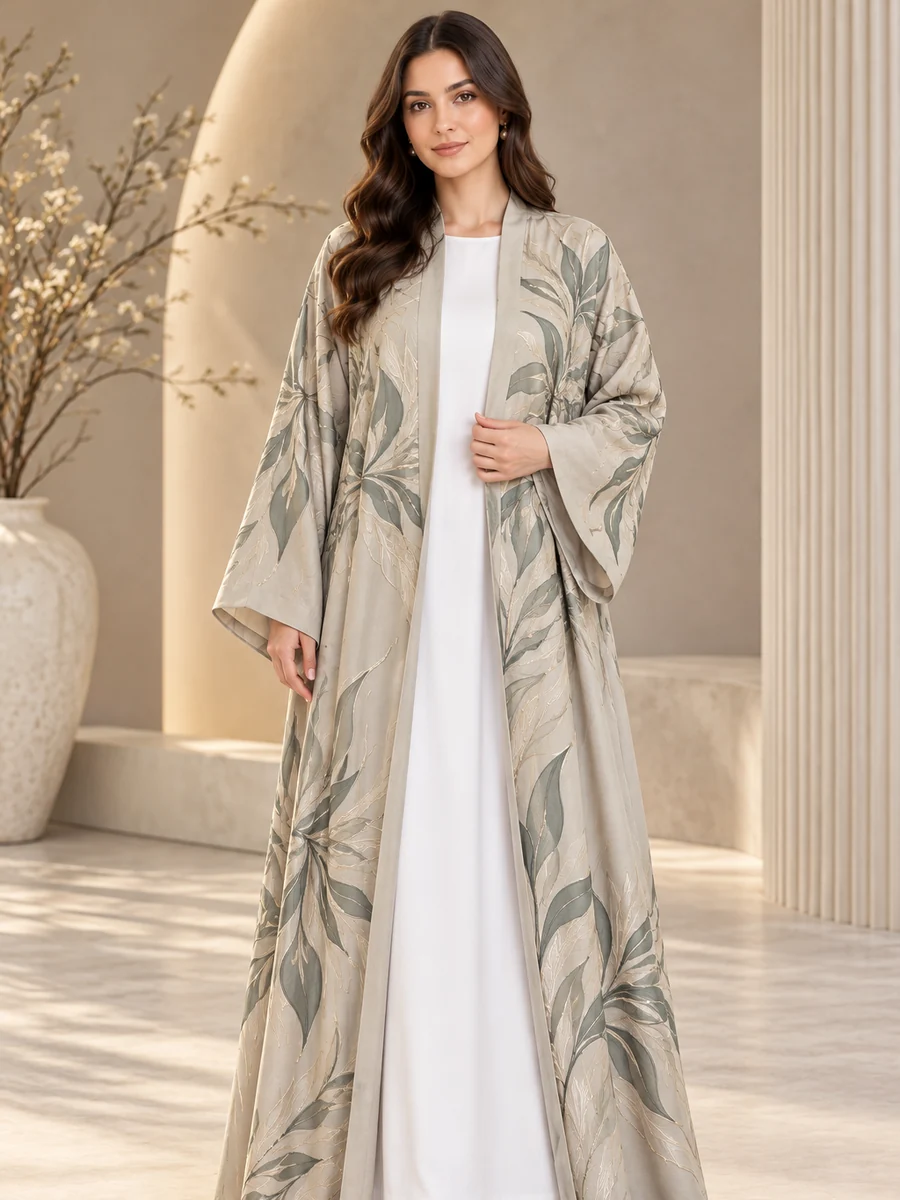
A Canadian modest-wear retailer's winter guide warns that wide sleeves pushed into narrow puffer sleeves bunch badly, and suggests a parka with wide sleeves. So in a cold market, stock butterfly abayas as indoor and evening pieces, and put everyday depth in narrower sleeves. Our open abaya collection describes the open cut worn like a light coat in the UK.
Sellers disagree on length, from a shorter abaya in rain to a coat as long as the abaya. A UK retailer's journal adds that satin can show water marks, and that some winter combinations cling when dry indoor air meets synthetic layers.
Common mistake: Buying only wide-sleeved styles for customers who wear fitted coats. They sell only for evenings. Before you order, ask three regular customers which coat they wear, and buy sleeves that fit inside it.
Which winter cloths can you prove on a spec sheet?
You can prove a winter cloth only by its fibres, with percentages, and its GSM, the weight in grams per square metre, written down. Names such as wool-look, tweed and velvet tell you neither. On 20 October 2026, 47 of 264 abaya-type products on 15 winter collection pages of 10 UK and US shops showed a fibre percentage, and none gave a GSM.
The checks come from our abaya fabric guide, the rules from US and GB law.
| Cloth as sold | What the name hides | Get in writing | Rule that applies |
|---|---|---|---|
| Wool blend, wool-look | Wool-look suiting can hold no wool | Wool share and other fibres | US: Part 300 if any wool; GB: Annex I names |
| Tweed, bouclé | A look, not a fibre | Fibre shares | US: Part 300 if any wool, else Part 303 |
| Velvet | The fibre under the pile | Fibre shares; sample GSM | US: raised surface, 16 CFR 1610 |
| Fleece or sherpa lining | The base fibre, which can be cotton | Lining fibre and share | US: a warmth lining goes on the label |
| Heavier crepe, formal nida | Trade names; weight varies | GSM and fibre | Legal fibre names on the label |
| Cashmere-touch | Whether there is any cashmere | The real fibres | US: cashmere is defined (16 CFR 300.19) |
Wool is the widest gap. On two US shops, at least 21 abaya-type products named wool or cashmere; 1 gave a wool share, and 4 were listed as acrylic cashmere.
Our fabric guide compares GSM only within one kind of fabric; general listings put velvet at about 220 to 285 GSM, so ask for your roll's figure. For everyday depth, the guide calls formal nida a cooler-month cloth (see the nida collection), and the crepe collection calls moss crepe heavier, for cooler seasons.
Ask the supplier: "What share of the outer cloth is wool, if any, and is each lining there for finish or for warmth? What is the GSM of the sample you sent me? For any velvet, fleece or brushed cloth that is not wholly polyester, nylon, acrylic, modacrylic, olefin or wool, can you send a flammability test report?" Hold the bulk order to those three answers.
What do wool blends and velvet need before a US or UK sale?
Wool blends and velvet each bring a US rule that a plain polyester abaya mostly avoids. Any garment with any wool falls under the Wool Products Labeling Act and its rules, 16 CFR Part 300. Velvet has a pile, which the US flammability standard, 16 CFR 1610, counts as a raised surface.
The US Federal Trade Commission (FTC) enforces it. Under 16 CFR 300.3, the wool share is always stated, even below 5%, with a business name or RN (a registered number the FTC issues) and the country of manufacture. The importer answers for the label, and a foreign supplier's guaranty is no defence.
In the US, recycled wool is named as such, with its percentage. In Great Britain, wool is an Annex I name in Regulation 1007/2011; ask the supplier or Trading Standards how recycled content should be described. Under its Article 8, a blend may say virgin wool only if all its wool is virgin and makes up at least 25% of the weight.
Under 16 CFR 1610, a raised cloth made entirely of acrylic, modacrylic, nylon, olefin, polyester or wool, or a mix of only those, is exempt from testing. A cotton, viscose or silk velvet, or a blend with any of them, is not, at any weight.
A raised cloth that burns in under 4.0 seconds with base burn (the flame reaches the cloth under the pile) is Class 3, which shall not be used for clothing. The US Consumer Product Safety Commission (CPSC) names cotton or cotton-blend reverse fleece and sherpa among cloths likely to land in Class 2 or 3.
Adult clothing needs a written General Certificate of Conformity, based on a test or a reasonable testing programme; no third-party lab is required, and in the US the importer is responsible for it. All of this is information, not legal advice: ask your customs broker, the FTC or the CPSC about your own stock. Rules for non-wool abayas are in our labelling guide for the US and UK.
Should velvet be an occasion line or an everyday line?
Velvet works best as a small occasion line for winter evenings and gatherings, not as the everyday warm piece. We found no published test of its warmth in an abaya. Our fabric guide calls velvet best dry cleaned, and says every panel must be cut with the pile running one way, which costs more fabric and time.
The pile crushes, so ask how velvet will be packed. A dry-clean-only label also needs a reasonable basis under the FTC's care labelling rule, 16 CFR Part 423.
Our fabric guide says abaya velvet is usually polyester, often with some spandex. Spandex is not on the exempt list, so ask your customs broker whether a stretch velvet needs a test report before it ships to a US shop.
To try a velvet first, a sample order has a value minimum of AED 2,000 and no piece count, and the pieces are yours to sell. The luxury abaya collection shows velvet beside jacquard and brocade.
Real talk: Velvet earns its place on winter evenings, at weddings and on the Ramadan 2028 nights at the end of the season. Keep it to one design, three deep. If your customers rarely dress up in winter, leave velvet out: a heavier crepe carries more of the season.
How do a Chicago shop and a Houston shop build two winter ranges?
A Chicago shop and a Houston shop can share six winter lines and split them differently. In this plan, Chicago takes 30 pieces in 8 designs, with coat and lined pieces for a January averaging 25.2 °F. Houston takes 24 pieces in 7 designs and leans on lighter abayas for a January averaging 53.8 °F.
This is a planning example, not sales data; prices are left out because heavier cloth is quoted per style.
| Line | Job in the range | Chicago (designs × pieces) | Houston (designs × pieces) | Carries into |
|---|---|---|---|---|
| Closed everyday abaya, heavier crepe or formal nida, black or navy | The middle layer under a coat | 2 × 4 = 8 | 2 × 4 = 8 | Ramadan 2028, spring |
| Open everyday abaya over knitwear, charcoal or camel | Layers on cold days | 2 × 4 = 8 | 1 × 3 = 3 | Spring |
| Coat-cut abaya, structured cloth | Workwear and outdoors | 1 × 4 = 4 | 1 × 2 = 2 | Next winter |
| Lined piece, only if your supplier makes a warmth lining | The coldest weeks | 1 × 3 = 3 | 0 | Next winter |
| Velvet occasion piece | Evenings and gatherings | 1 × 3 = 3 | 1 × 3 = 3 | Ramadan 2028 |
| Lighter everyday abaya | Heated rooms, mild days | 1 × 4 = 4 | 2 × 4 = 8 | All year |
| Total | 8 designs, 30 pieces | 7 designs, 24 pieces |
Chicago: 8 + 8 + 4 + 3 + 3 + 4 = 30 pieces, in 2 + 2 + 1 + 1 + 1 + 1 = 8 designs. Houston: 8 + 3 + 2 + 0 + 3 + 8 = 24 pieces, in 7 designs.
Both orders pass the 20-piece floor. At the AED 90 entry price, AED 2,000 takes 23 pieces, and both orders pass that count too. The Houston column is the honest plan for a mild city: most of its depth sits in everyday pieces that carry past winter.
For the velvet and occasion lines, browse the catalogue's velvet and jacquard designs and ask for a written spec on your shortlist.
Quick maths: If the coat and lined lines do not sell, Chicago holds 4 + 3 = 7 of 30 pieces until next winter: 7 ÷ 30 = about 23% of the order. Houston holds 2 of 24, about 8%. Drop the lined line and Chicago holds 4 of 27, about 15%, and 27 pieces still clears 20 and 23.
Send the column you would order, with each line's cloth and colour, through the contact page. We will reply in writing on which lines we can make and whether it meets both minimums.
What goes wrong once heavier winter pieces ship?
Heavier winter pieces go wrong after shipping in three ways: freight priced on bulk, care labels with no basis, and seams or linings that give way. Couriers charge on whichever is greater, actual weight or volumetric weight (a weight worked out from carton size), so lined coats can cost more to send than their scale weight suggests.
Our shipping and landed cost page publishes one carton figure, for satin only: 6 pieces at about 4.5 kg actual and about 6 kg volumetric. We publish none for velvet or coats, so ask for the carton weight and size of your actual styles before comparing quotes. A wool-blend abaya may also fall under a different tariff line from a polyester one; ask your customs broker for the heading and rate on the day you ship.
Wool can shrink if it is washed warm, so ask what the care label's instruction is based on before you print it. Shoppers' reviews also mention linings that came away from the shell, so agree seam and lining checks before bulk starts; what we inspect on every order is on our quality control page.
What can a late buyer still stock this winter?
A late buyer this winter can still stock mid-weight everyday pieces and a small velvet line, if the supplier gives a delivery date in writing. Skip coats and lined pieces. The odds argue for a shallow buy too: last winter ran warm in the Met Office's UK series, and NOAA's outlook tilts the odds warmer for much of the northern US.
This is planning judgement, not a lead time.
| If you are buying in | What still makes sense | What to drop or move |
|---|---|---|
| Late October or November 2026 | Mid-weight everyday pieces; a small velvet line for December | Coats and lined pieces, unless a date is given in writing |
| December 2026 | Pieces that also sell into Ramadan 2027, expected around 8 February 2027, subject to moon sighting | Anything only for the coldest weeks |
| January 2027 or later | A sample of next winter's cloth | This winter: plan winter 2027 to 2028 instead |
NOAA's November to January outlook, with a very strong El Niño favoured to last into spring 2027, gives odds, not a forecast, and covers this winter, not winter 2027 to 2028. The Met Office's UK series puts last winter at 4.94 °C, about 0.9 °C above the 1991 to 2020 winter average of 4.08 °C.
From December, follow our Ramadan and Eid range guide instead.
Which winter pieces can still sell at Ramadan 2028 and in spring?
Dark everyday abayas and velvet evening pieces can carry from winter into Ramadan 2028, expected in late January or early February 2028, subject to moon sighting. Lighter everyday pieces carry into spring. Coat cuts and lined pieces usually wait for next winter. That matters because January is the slowest month of the year for US clothing stores in general.
US Census Bureau advance figures for all clothing stores put December 2025 sales at US$39,105 million and January 2026 at US$19,222 million, so January was about 49% of December. That is all clothing, not abayas, and recent months get revised.
Keep carry-over pieces at full price into Ramadan. No shop we read publishes what its winter stock sold or left over, so fix the day you will cut prices before you buy. Eid al-Fitr is expected in late February or early March 2028, subject to moon sighting, a natural point to clear the rest.
Next step
Three decisions matter. Set the cloth by your customers' January in degrees, not by the word winter on a tag. Get every fibre, share and GSM in writing, with a test report for any raised cloth outside the exempt list. Then buy deep only in mid-weight everyday pieces.
We manage production from start to finish: your abayas are made in the UAE to a spec sheet you approve, and each order is inspected and photographed before it leaves. You pay a 50–60% deposit, then the balance against photos of your packed cartons, as our payment terms page sets out. We ship to 40 countries, the US, UK and Canada among them, as our shipping destinations page lists.
List your winter plan line by line, with cloth, colours, lengths and your on-sale date. Send that list through the contact page, and within 24 hours we will reply in writing on both minimums and on the lines we can make.
Frequently asked questions
Is a fleece-lined abaya warm enough for freezing weather?
Nobody can promise that, because we found no published test of how warm any abaya cloth or lining is. In Environment Canada's 1981 to 2010 normals, Toronto averages about -5.5 °C in January, with about 9 days of wind chill below -20. Many wearers put a coat over the abaya in that cold. If you sell a lining as being for warmth in the US, its fibre goes on the label; your customs broker can confirm the wording.
Does a wool blend abaya label have to show the wool percentage?
Yes, in the US. The FTC's Wool Rules, 16 CFR Part 300, say the share of wool or recycled wool is always stated, even below 5%, where other small fibres can be grouped as other fiber. The importer answers for the label. In Great Britain, wool is one of the legal fibre names in Annex I of Regulation 1007/2011. Get every fibre and its share from the supplier in writing, and check your label with a customs broker or Trading Standards.
Can a wool blend abaya be called virgin wool?
Only under strict conditions, and the US and Great Britain differ. The US Wool Rules allow virgin or new wool only for fibre never reclaimed from any made or used product. Article 8 of Regulation 1007/2011, as it applies in Great Britain, also needs all the wool in a blend to qualify and to be at least 25% of its weight, with the full composition given. Ask your customs broker or Trading Standards before printing it.
Do velvet abayas need a flammability test to sell in the US?
It depends on the fibre. The US clothing flammability standard, 16 CFR 1610, counts any pile as a raised surface. A velvet made wholly of polyester, nylon, acrylic, modacrylic, olefin or wool, or a mix of only those, is exempt from testing. A cotton, viscose or silk velvet, or a blend with any of them, is not, at any weight. The exemption covers testing, not the standard itself, so ask your customs broker or the CPSC.
Can a polyester abaya be sold as cashmere-touch?
It is risky. In the US, cashmere is a defined fibre name, kept for the fine undercoat of the cashmere goat (16 CFR 300.19). A polyester or acrylic piece sold as cashmere-touch risks misleading your customer, so check the wording with your customs broker before you use it. On two US shops' winter pages we read on 20 October 2026, at least 21 abaya-type products named wool or cashmere, and 4 of them were listed as acrylic cashmere.
Is a winter range worth stocking for a shop in Texas or California?
A small, light one usually is, and a heavy one rarely. NOAA's 1991 to 2020 normals put the January average at 46.3 °F at Dallas/Fort Worth, 53.8 °F at Houston and 57.9 °F at Los Angeles airport. In the Houston plan in this guide, a third of the pieces are lighter everyday abayas that sell all year, and only 2 are coat cuts.
Does a UK shop need different winter abayas from a Chicago shop?
Usually, yes. The Met Office's UK-wide January average for 1991 to 2020 is 3.92 °C, about 39 °F, while Chicago O'Hare averages 25.2 °F in NOAA's normals. The UK is milder but wetter and darker: 344.8 mm of rain and 162 hours of sun from December to February. A UK range leans on mid-weight cloth that copes with rain; a Chicago range needs room for heavier layers.
Should customers size up a winter abaya to fit layers?
It depends on the cut. A fitted coat cut sits closer through the shoulders and chest, like a jacket, so a customer wearing a thick layer underneath may need one size up. Loose open and wide cuts usually have room already. Try a sample on a person wearing a jumper, then put a short fit note on each listing so shoppers can choose without guessing.
Can a butterfly abaya be worn under a winter coat?
Only under the right coat. A Canadian modest-wear retailer's winter guide warns that wide sleeves forced into narrow, elasticated puffer sleeves bunch uncomfortably. It suggests a parka with dropped shoulders or wide sleeves instead. For a shop, that makes butterfly cuts an indoor and occasion piece in winter rather than the everyday line.
Will winter abayas still sell when Ramadan 2028 begins?
Some will, if you chose them for it. Ramadan 2028 is expected in late January or early February 2028, subject to moon sighting. Dark everyday abayas and velvet evening pieces can move into that season. US Census Bureau figures for all clothing stores make January the slowest month of the year, so a Ramadan reason to shop helps. No page we read publishes abaya sales by month.
How many winter abayas should a small boutique buy per design?
Under a whole-order minimum, three or four of a design can be enough for a first winter. One AI search answer we ran for a UK boutique on 20 October 2026 advised 60 to 90 pieces across 3 designs, at 15 to 35 per design. In the Chicago plan in this guide no design goes deeper than 4 pieces, 30 pieces across 8 designs, and the order still clears Dubai Abaya's minimum of 20 pieces and AED 2,000.
Do heavier winter abayas cost more to ship?
Usually, yes. Heavier cloth and linings add weight and bulk, and couriers charge on whichever is greater, actual or volumetric weight. A carton of velvet or lined coat cuts weighs more than the same count of a light cloth. Ask for the carton weight and size of your actual styles before you compare freight quotes, and price a winter order on those figures.
Sources
- Khaleej Times: likely 2027 dates for Ramadan, Eid al-Fitr and Eid al-Adha (UAE Astronomy Centre, 22 August 2026), Ramadan 2027 expected around 8 February
- NOAA National Centers for Environmental Information: U.S. Climate Normals 1991 to 2020, monthly winter normals by station
- Met Office: HadUK-Grid UK areal series, mean temperature, monthly and seasonal values (1991 to 2020 averages; winter 2026)
- Environment and Climate Change Canada: Climate Normals 1981 to 2010, Toronto Pearson
- Environment and Climate Change Canada: Climate Normals 1981 to 2010, Montreal Trudeau
- Met Office: historic station data, Heathrow, January highs, lows and frost days, 1991 to 2020
- Met Office: historic station data, Bradford, January highs, lows and frost days
- Met Office: HadUK-Grid UK areal series, rainfall, 1991 to 2020 December to February total
- Met Office: HadUK-Grid UK areal series, sunshine, 1991 to 2020 December to February total
- US Census Bureau: Advance Monthly Retail Trade, clothing stores, not seasonally adjusted (series RSCCASN via FRED), October to February shares
- GOV.UK: School term and holiday dates, set by each local council
- Bernama, citing the Saudi Ministry of Hajj and Umrah: Umrah season calendar 1448 AH (17 May 2026)
- eCFR: 16 CFR Part 300, Rules under the Wool Products Labeling Act, wool share, linings, virgin wool and cashmere
- US Federal Trade Commission: Threading Your Way Through the Labeling Requirements Under the Textile and Wool Acts, the importer's responsibility
- legislation.gov.uk: Regulation (EU) No 1007/2011 as it applies in Great Britain, Annex I, textile fibre names
- legislation.gov.uk: Regulation (EU) No 1007/2011 as it applies in Great Britain, Article 8, virgin wool and fleece wool
- eCFR: 16 CFR Part 1610, Standard for the Flammability of Clothing Textiles, raised-surface fabrics, exemptions and classes
- US Consumer Product Safety Commission: Summary Information for Clothing Textiles, 16 CFR Part 1610 (March 2023)
- US Consumer Product Safety Commission: Clothing FAQ, General Certificates of Conformity for adult apparel
- eCFR: 16 CFR Part 423, Care Labeling of Textile Wearing Apparel, a reasonable basis for care instructions
- NOAA Climate Prediction Center: Prognostic Discussion for Long-Lead Seasonal Outlooks (15 October 2026), November 2026 to January 2027 odds
Our own figures (minimums, prices, deposits, lead times) match our published terms and change everywhere on this site at once. Duty, freight and market figures from third parties are dated and sourced; check them with your broker before you rely on them.