Types of Abayas Explained: Open, Closed, Kimono, Butterfly, Farasha and More
8 abaya types in one table, from open and closed to kimono, butterfly and farasha, with who buys each. Plus abaya vs jilbab vs kaftan.
By Dubai AbayaPublished 10 min read
Short answer
What are the different types of abayas?
Abayas sort first by how they open, then by the shape of the sleeve and body. The main cuts are open, closed, kimono, butterfly (also sold as batwing or farasha), umbrella, coat and bisht-style. Embroidered and luxury are not cuts. They are finishes, and any of the cuts above can carry them.
Key takeaways
- Abayas sort by opening first. Open cuts are worn over an outfit; closed cuts go on over the head as one piece.
- Butterfly, batwing and farasha are one construction under three names. Farasha is Arabic for butterfly.
- Embroidered and luxury are finishes, not cuts, and each one moves the price up from AED 90 a piece.
- An abaya is worn over clothes. A kaftan and a jalabiya are the outfit itself. 'Jilbab' changes meaning by market.
- Open abayas are Dubai Abaya's best seller in the US, UK and EU. Closed abayas are the daily-wear standard across much of the Gulf.
Abaya names are used loosely. One supplier's "kimono" is another's "duster", and a quote for "farasha" can mean a wide-sleeve abaya or a kaftan-style gown. Compare prices across names that do not match and you compare different garments.
This guide gives each type one plain definition, then who buys it. Cuts come first, because the cut decides who an abaya sells to. Finishes come after, because they can go on any cut.
What are the different types of abayas?
Abayas sort first by how they open, then by the shape of the sleeve and body. The main cuts are open, closed, kimono, butterfly (also sold as batwing or farasha), umbrella, coat and bisht-style. Embroidered and luxury are not cuts. They are finishes, and any of the cuts above can carry them.
Each type has its own section below the table.
| Type | Silhouette | Typical fabric | Who it sells to |
|---|---|---|---|
| Open (front-open, cardigan) | No front fastening, set-in sleeve, worn over an inner dress | Satin, nida, crepe | UK, US and EU shops; first orders |
| Closed (overhead) | One piece, goes on over the head | Nida, crepe | Gulf daily wear; prayer, Umrah and Hajj buyers |
| Kimono | Open front, wide sleeve cut with the body | Nida, satin, crepe | Younger UK and US customers |
| Butterfly or batwing | One panel from wrist to hem, opens like a wing | Nida, crepe, satin | Eid, occasions, shops that sell through photos |
| Farasha | The butterfly cut, Arabic name | Nida, chiffon; velvet in winter | Ramadan and Eid buying |
| Umbrella or flared | Fitted top, wide flare to the hem | Nida, chiffon | Occasion wear; little market data |
| Coat or trench | Tailored, structured shoulders, often lined | Crepe or heavier cloth | Workwear in colder markets, winter |
| Bisht-style | Open cloak, wide shoulders | Crepe or heavier cloth | Statement outerwear; little market data |
| Embroidered (finish) | Any cut | Any; priced by placement | Occasion stock; your own artwork |
| Luxury (finish) | Any cut | Silk, velvet, jacquard; fully lined | Formal-occasion customers |
If two suppliers use different names for what looks like the same style, ask each one for the flat measurement across the sleeve at its widest. That single number tells you more than the name does. For how the same cut behaves in different cloth, see the abaya fabric guide.
What is an open abaya?
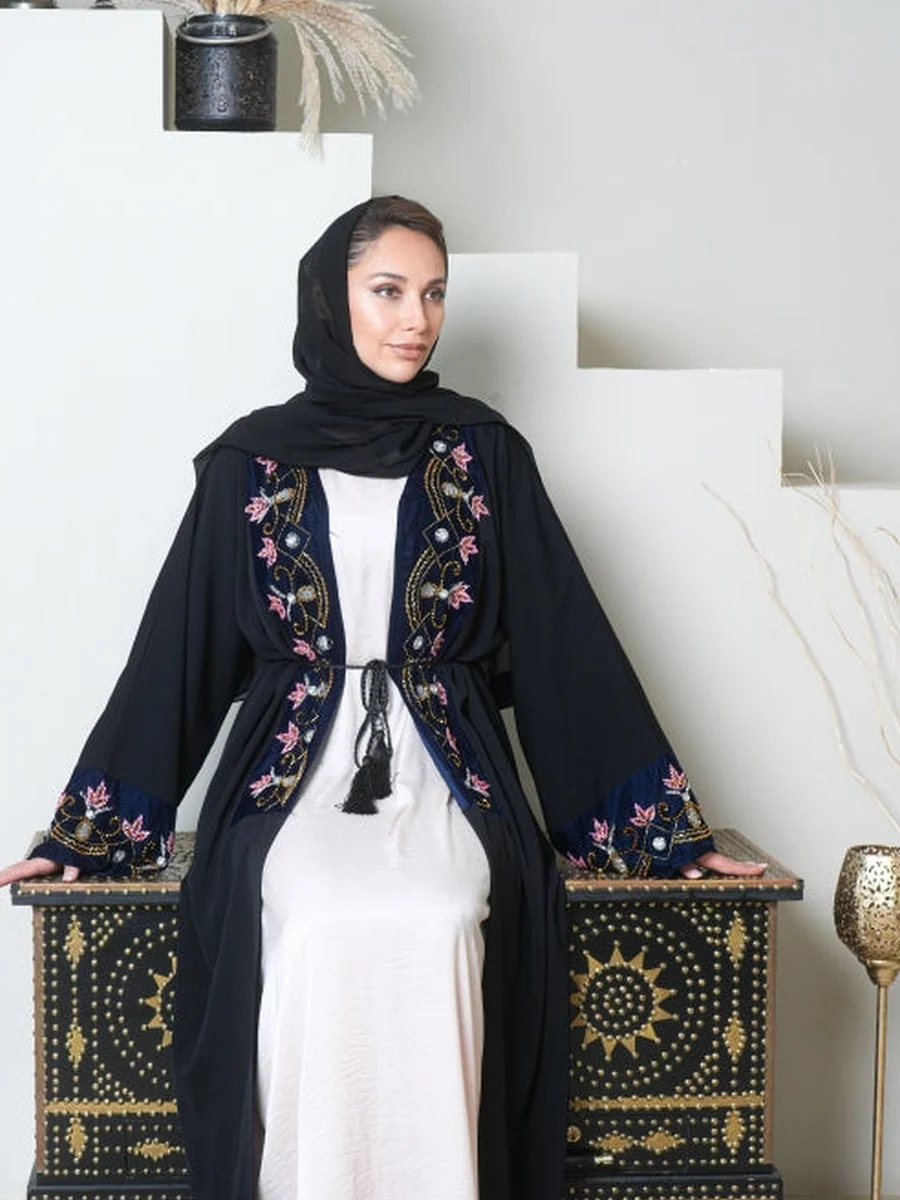
An open abaya has no front fastening. It falls open down the front and is worn over an outfit like a long coat, usually with a matching inner dress. It is also sold as a front-open abaya. A cardigan abaya is the slimmer version, with a tie or a single fastening at the waist.
Open abayas are Dubai Abaya's best seller in the US, the UK and the EU, and the safest first order a new shop can place. Al Jazeera's 2026 look at modest fashion described European buyers as favouring minimal, layered daywear, which is the job an open cut does. See the open abaya collection.
The catch: an open abaya needs something underneath. If a supplier prices the abaya alone, your customer still needs an inner dress, so check whether a quote is for the piece or the set.
What is a closed abaya?
A closed abaya has no front opening. It goes on over the head as one complete garment, which is why it is also called an overhead abaya, and it needs no separate inner dress. Some closed styles use a hidden zip or a button placket so they are easier to get on, but they still close fully.
Closed cuts are the daily-wear standard across much of the Gulf, and the cut prayer, Umrah and Hajj buyers ask for most. The appeal is speed: one garment, one movement, nothing to match. See the closed abaya collection.
The trade-off: it takes more care over a styled headscarf, and there are fewer ways to wear it than an open one. Most shops carry both.
What is a kimono abaya?
A kimono abaya is an open-front abaya with wide sleeves cut in one piece with the body, so the whole garment hangs in a relaxed line from the shoulder. There is no front fastening. The name describes proportions borrowed from the Japanese kimono. The garment itself is modest wear, usually sold with an inner dress.
The difference from an open abaya is the sleeve: set-in and straight on an open abaya, wide and part of the body on a kimono. It is the relaxed shape younger customers in the UK and the US keep asking for. Accio's summary of Google search data put "kimono abaya" ahead of every other named abaya style for search interest through 2025. Treat that as a direction, not a sales forecast. See the kimono abaya collection.
Watch the word "duster". Many suppliers use it for exactly this cut. Others use it for a two-piece product, a separate outer layer sold with its own dress. Ask which one a supplier means before you order.
What is a butterfly or batwing abaya?
A butterfly abaya has no set-in sleeve. The fabric runs as one continuous panel from the wrist down to the hem, so the abaya hangs full with the arms down and opens like a wing when they lift. Batwing is the same construction under another name, and farasha is the Arabic name for it.
This is the cut that carries a shop's photography, because it moves on camera in a way a set-in sleeve does not. It sells for Eid and occasion wear, and Sootra's abaya guide notes that Saudi taste favours maximum volume and the traditional butterfly cut. See the butterfly and batwing collection.
Two downsides. It uses a lot of cloth, which shows in the price, and a wide sleeve catches on things, so it suits an occasion customer more than an everyday one.
Is a farasha the same as a butterfly abaya?
Yes. Farasha is Arabic for butterfly, and it names the same wide, cape-sleeved abaya. It is the word Gulf buyers use when they stock this cut for Ramadan and Eid. A farasha is still an abaya, worn over clothes. It is not a kaftan and not a prayer dress, whatever a listing title says.
Why its own entry, then? Because the word carries a season. A farasha order runs on the Ramadan calendar, not on impulse. See the farasha collection, and the Ramadan ordering calendar for when to place it.
Some sellers use "farasha" for a loose, kaftan-style gown worn on its own. If a quote says farasha, ask whether the piece is worn over clothes. If it is not, you are being quoted a kaftan.
What is an umbrella abaya?
An umbrella abaya is fitted through the top, then flares out wide to the hem, like an open umbrella. Flared and bell cuts are close cousins, widening from the waist or just below the bust. An A-line is the gentle version: narrow at the shoulder, widening slowly to the hem, without much volume.
East Essence's plus-size buying guide recommends the A-line for larger customers, because it gives movement without adding bulk.
Our research found no reliable data on which markets buy umbrella cuts most. Treat one as a statement piece and add a few to a mixed order first. A wide flare also puts a lot of fabric in the hem, which adds cost and weight. There is no collection page for it here, so ask for it as a custom style.
What is a coat abaya?
A coat abaya is cut like a tailored outer coat: structured shoulders, often lapels, and a button or belted front. Many are lined for warmth. A trench abaya is the same idea borrowed from the trench coat. It reads as workwear, and it is the most seasonal cut in this guide.
The abaya guides from By Malbus and Sootra describe it as favoured by working women and selling in colder markets such as the UK and North America, and in Turkey, where the fitted line borrows from the trench coat.
The downside is the calendar. In most markets this is an autumn and winter piece. Heavier cloth and a lining cost more, and stock left on the rail in spring waits months for its next season. Order it in smaller numbers than your year-round cuts. Like the umbrella cut, it is a custom style here.
What is a bisht-style abaya?
A bisht is a men's cloak, worn over the thobe on special occasions and traditionally made from goat wool and camel hair, often edged with gold or silver zari embroidery. A bisht-style abaya borrows that open, cloak-like shape for women. Call it bisht-style or bisht-inspired. A women's abaya listed simply as a "bisht" reads as an outsider's mistake.
It needs a cloth with enough body to hold the wide shoulder. We found no reliable data on who buys it most, so treat it as statement outerwear: a few pieces in a mixed order, not a full run.
Are embroidered and luxury abayas separate types?
No. Embroidered and luxury describe how an abaya is finished, not how it is cut. A kimono, a closed abaya or a farasha can each be plain, embroidered or luxury. Choose the cut first, for your customer, then choose the finish, for your price point, because each addition moves the cost up.
Embroidered
"Embroidered" covers four different jobs: machine embroidery, hand embroidery, beadwork and stone setting. They cost very different amounts and fail in different ways, so name the one you want. Machine work is even and repeatable, and it is how your own logo or artwork goes onto a private-label run. Hand work is slower, costs more and varies a little from piece to piece. Our embroidered abayas are priced by placement (cuff, neckline, hem, front panel or all-over), so you can see what each addition costs.
Luxury
Luxury should mean something you can check. There are three levers. The fabric: silk, velvet or jacquard rather than nida. The lining: fully lined rather than unlined. The finishing: hand-finished seams, hand embroidery or beadwork. Each style in our luxury collection says which of the three you are paying for. If a supplier cannot explain their "luxury" piece in those terms, the word is an adjective, not a spec.
Every price on this site starts from AED 90 a piece for the plainest fabric and the simplest stitch. Heavier cloth, lining, embroidery and beadwork all move it up. To test a few higher-value styles without placing a full order, a sample order has no piece minimum, only a AED 2,000 value minimum, and it is stock you keep and sell.
What is the difference between an abaya, a jilbab and a kaftan?
An abaya is a full-length overgarment worn over clothes. A kaftan is a loose, wide-sleeved robe worn as the outfit itself, usually at home or on holiday. A jilbab is also a long, loose outer garment, but the word has no fixed trade meaning. It changes by market, so ask each seller what they mean.
| Garment | What it is | Worn over clothes? | Typical use |
|---|---|---|---|
| Abaya | Full-length overgarment, open or closed | Yes | Daily wear, occasions, prayer |
| Kaftan | Loose, wide-sleeved robe with Persian, Ottoman and Moroccan roots | No, it is the outfit | Home and resort wear; heavily embellished Moroccan kaftans are wedding dress |
| Jilbab | Long, loose outer garment; the exact meaning varies by market | Depends on the seller | Sold by some as an abaya, by others as a two-piece set or as prayer wear |
| Jalabiya | Egypt's traditional one-piece robe-dress, worn by men and women | No, it is the outfit | Home, casual gatherings, Ramadan evenings |
The jalabiya is in the table because it turns up in the same listings. Like most kaftans, it is an outfit worn around the home.
Treat "jilbab" as a word to clarify, not a word to compare on. Depending on the seller and the country, it can mean a long outer garment much like an abaya, a two-piece overhead set worn with a khimar, or a garment made for prayer. Before you compare two jilbab quotes, get a photo and the flat measurements of each.
Get this right in your own product titles. Calling a kaftan an abaya is a quick way to look like an outsider to a Gulf customer.
Which abaya types should a new shop order first?
Start with the cut your customers already wear, not the one trending online. For most UK, US and EU shops that is the open abaya with its inner dress. Shops selling into the Gulf, or to prayer and Umrah customers, should look at closed cuts first. Add one statement cut, butterfly or kimono, once the basics sell.
You do not have to pick one. The minimum counts across the whole order: 20 pieces and AED 2,000, in any mix of cuts, colours and sizes, whichever you reach last. At the AED 90 entry price that is 23 pieces. So a first order can be mostly open abayas plus a few kimono or butterfly pieces to test. Abaya MOQ explained sets out how per-order and per-style minimums differ between suppliers.
When you know your market, send the cuts you are weighing up through the contact page, and you will have a quote within 24 hours.
Frequently asked questions
Which type of abaya sells best?
It depends on the market. Open abayas are our best seller in the US, the UK and the EU. Closed abayas are the daily-wear standard across much of the Gulf and the cut prayer, Umrah and Hajj buyers ask for most. Butterfly and farasha cuts sell for Eid and Ramadan. Match the cut to your customer before you follow a trend.
What is the difference between an open abaya and a kimono abaya?
Both open at the front and are worn over an inner dress. The difference is the sleeve. An open abaya has a straight sleeve set into the armhole and sits closer to the body. A kimono abaya has a wide sleeve cut in one piece with the body, so the whole garment hangs looser.
Is a batwing abaya the same as a butterfly abaya?
Yes. Both names describe the same construction: one panel of fabric running from the wrist to the hem instead of a set-in sleeve, which opens like a wing when the arms lift. Farasha is the Arabic name for the same cut. To compare quotes, ask for the flat measurement across the sleeve at its widest.
Can I mix different abaya types in one wholesale order?
Yes. The 20-piece minimum and the AED 2,000 minimum order value both count across the whole order, in any mix of cuts, colours and sizes. An order has to reach both, so whichever you reach last is the one that decides. At the AED 90 entry price, that is 23 pieces.
What is a duster abaya?
Usually a kimono-style open abaya, but not always. Many suppliers use 'duster' for the wide-sleeve, open-front kimono cut. Others use it for a two-piece product: a separate outer layer sold with its own dress. Before you order anything called a duster, ask which one the supplier means and ask for a photo of the full set.
Can a women's abaya be called a bisht?
Not accurately. A bisht is a men's cloak worn over the thobe on special occasions. Women's abayas that borrow its open, wide-shouldered shape should be listed as bisht-style or bisht-inspired. A product title that calls a women's abaya a plain 'bisht' tells a Gulf customer the seller does not know the garment.
Sources
- Al Jazeera, feature on global modest fashion markets (17 May 2026)
- Accio, popular abaya styles 2026 trend summary
- Sootra, complete abaya guide
- By Malbus, different types of abaya for women
- East Essence, plus-size abaya buying guide
- Wikipedia, Bisht (clothing)
- Hera Closet, kaftan vs jalabiya
- Vilmere, kaftan vs abaya vs jalabiya
- Egyptian Streets, feature on the jalabiya (28 February 2022)
Our own figures (minimums, prices, deposits, lead times) match our published terms and change everywhere on this site at once. Duty, freight and market figures from third parties are dated and sourced; check them with your broker before you rely on them.