OEM vs ODM vs Private Label: Which Does a New Abaya Brand Need?
Private label, ODM and OEM abayas compared on minimums, cost, lead time, samples and design ownership, and why woven labels come in runs of 500 to 1,000.
By Dubai AbayaPublished 10 min read
Short answer
What is the difference between OEM and ODM for abayas?
ODM means a factory adapts one of its own abaya designs for you, changing the length, sleeve, neckline or fabric. OEM means the factory makes your design from your pattern or tech pack. Private label is simpler still: its existing design, your labels. Each step up adds cost, sampling and lead time, and gives you more control of the design.
Key takeaways
- Private label puts your labels on a design the factory already makes. ODM adapts that design for you. OEM makes your own design.
- At Dubai Abaya, all three routes share one garment minimum: 20 pieces and AED 2,000 an order, in any mix.
- Woven label makers set their own minimum, usually 500 to 1,000 labels, separate from the garment minimum.
- Heat seal and printed satin labels have much lower minimums, which suits a first run.
- Catalogue styles stay open to other buyers. A design developed with you should be kept for you, in writing.
Ask a factory to make abayas under your own name and three terms come straight back: private label, ODM and OEM. They describe how much of the design is yours. That one question decides what you pay before a single piece is sewn, how long you wait, how many samples you sign off, and whether the shop down the road can sell the same abaya as you.
This guide defines each route, compares them in one table, and says which one a first brand should start with.
What is the difference between OEM and ODM for abayas?
ODM (original design manufacturer) starts from a design the factory already makes and changes it for you: a longer sleeve, a different length, another fabric. OEM (original equipment manufacturer) starts from your design, whether that is a tech pack, a sketch or a garment you post in, and the factory drafts a new pattern from it.
Private label sits one step before both. In one sentence each:
- Private label: the factory's existing design, made in the colours and sizes you choose, carrying your labels, tags and packaging.
- ODM: the factory's design, adapted for you.
- OEM: your own design, made to your pattern or tech pack.
The terms come from general manufacturing and get used loosely in clothing. Some suppliers call a catalogue abaya with your label in it ODM, which is private label under another name. Others, including our own private label page, split private label in two: white label when a catalogue design stays open to other buyers, and private label when the design is developed for you alone. Don't argue about the word. Ask what the factory will change, and whether anyone else can buy the result.
How do private label, ODM and OEM compare?
Private label is the cheapest and fastest route, because the pattern already exists and you only add branding. ODM sits in between: your change needs pattern work and a sample, but the base already fits. OEM costs most on the first run, takes longest and carries the most risk, but gives you a design that is fully yours.
| Private label | ODM | OEM | |
|---|---|---|---|
| What you bring | Logo and care wording | A catalogue style and the change you want | A photo, sketch, garment or tech pack |
| Garment minimum at Dubai Abaya | 20 pieces and AED 2,000, any mix | The same | The same |
| Extra cost before bulk | Labels, tags and packaging | Plus pattern work and a sample for the change | Plus a pattern fee per design, and sampling |
| Lead time at Dubai Abaya | 19–28 working days | Between the two, set in your quote | 22–30 working days (repeats 12–18) |
| Samples | One branded sample | Often a single pre-production sample | Proto, fit and pre-production |
| Who owns the design | The supplier; other shops can buy it | Agree it in writing | You, in writing |
| Main risk | A rival sells the same abaya | Paying for a change buyers don't notice | Paying for development before it sells |
Lead times are working days from cleared deposit to dispatch, with sampling included, as set out on our lead times page. Transit comes on top.
Three rows need a word of explanation.
Minimums. At Dubai Abaya the minimum is on the whole order, not per style or per colour, and it is the same whichever route you take. That is not the norm. Published abaya minimums start at 10 pieces per style (Mariam's Collection) and reach 100 pieces of each colour per design for custom work at one Chinese factory (O'Harry Garment). General cut-and-sew guides put overseas full-package minimums at 300 to 1,000 or more per style (Arcus). Always ask whether a quoted minimum counts per order, per style or per colour. Abaya MOQ explained goes through what each one does to a first order.
Cost. Every route starts from the same AED 90 entry price. Custom work sits above it, because a new pattern, a sampling round and a slower first run all cost money that a catalogue style has already paid off. The pattern fee is charged once. A repeat order never pays it again, which is why the second run of an OEM style is much cheaper per piece than the first. Abaya factories rarely publish what pattern work costs. As an outside marker from general clothing, one guide puts pattern and grading at $150 to $600 or more per style, and a first prototype at $100 to $400 or more (Arcus). Treat that as a rough scale, not an abaya price.
Samples. For private label you get one finished abaya with your branding on it, and one round of changes is included. OEM can run through three samples: a proto to test the shape, a fit sample in the real fabric, and a pre-production sample that is sealed and used to check the bulk run. One round of changes is included there too, and a second is priced before it starts. For comparison, one general cut-and-sew guide says most products need two to three rounds (Thygesen Apparel).
Which one should a first-time abaya brand start with?
Start with private label on catalogue styles, using printed or heat seal labels. It needs the least cash, arrives fastest and teaches you what your customers buy. If you have never sold an abaya at all, go one step lower and test plain stock first, because branding stock that does not sell is an expensive way to store a mistake.
Your first order is a test, whatever you call it. What a new brand usually gets wrong is the range: which styles, which colours, how deep in each size. Private label lets you spread your minimum across many styles, see what sells, and only then spend on the things that are hard to undo. A sample order has no piece minimum, only a value of AED 2,000, so it is a cheap way to check fabric and fit before any label is made.
Now the bad part. A catalogue style is open to every buyer. Another shop can order the same abaya with their label in it, and you cannot stop them. At this stage your defence is your photos and how fast you restock, not the cut. That is fine for a first season. It stops being fine once you find a style that sells, which is the signal to move up.
Starting with OEM is the opposite bet. You pay for a pattern and a sampling round before you know whether the cut sells, and your first run is the most expensive one you will ever buy of that style. If you have a clear design and customers already asking for it, that can be the right call. If you are still finding your customer, it rarely is.
When should you move up to ODM or OEM?
Move to ODM when a catalogue style sells and customers keep asking for one change, such as a longer sleeve or a different length. Move to OEM when the cut itself is the reason people buy from you, or when you see the abaya you sell on a competitor's page. Both make most sense once a style has reordered.
Signs it is time:
- You have reordered the same style more than once. Development is paid once and spread over every later run, so it only pays back on styles that repeat.
- Returns cluster around one fit problem. A common one: in standard grading, width is tied to length, so a tall, slim customer gets a 60 that is too wide. Changing an existing style can fix that.
- A rival is selling your exact abaya. That is the cost of catalogue styles, and your own design is the way out.
- You can give it the time. A first OEM run takes 22–30 working days at Dubai Abaya, but the real delay is usually the decisions on your sample, not the sewing.
The second run is where OEM pays you back. With the pattern and sampling done, a repeat of an approved style runs in 12–18 working days, the same as any made-to-order style. That gap is the main argument for developing a style properly once rather than patching it every season. The custom manufacturing page has the full terms.
Why are label minimums separate from the garment minimum?
Labels are made by a different business. A label weaver sets up its machine once per design, so it sells woven labels in runs, usually 500 to 1,000. That minimum has nothing to do with how many abayas the factory will sew, so a small first order can need far more labels than garments.
It is also why a supplier's minimum can climb after you choose your trims. Fabric mills, trim makers and label weavers all set their own minimums, and any one of them can force a bigger buy even when the sewing floor is flexible (Arcus). Packaging works the same way: printed bags and boxes come from a printer with its own run. Branded packaging from Dubai Abaya starts at 300 units.
For scale, one Istanbul supplier sells custom labels at €100 for 1,000 and notes that sewing them in is not included (Hicabistan). A few online label shops will weave very small runs. One lists a minimum of five labels and a standard turnaround of 15 business days (Quality Woven Labels). Check the unit price, and add their production time to yours.
The label you choose decides how much of this reaches you:
| Label type | Minimum | Best for |
|---|---|---|
| Heat seal, printed and pressed in | Low | A first order under about 50 pieces |
| Printed satin, sewn in | Lower than woven | A middle step; softer at the neck and holds fine detail |
| Woven damask, sewn in | Usually 500 to 1,000 from the weaver | Styles you know you will reorder |
| Your own existing labels | None; you post them in | Brands moving from another supplier |
If you know you will reorder, buying 1,000 woven labels once works out cheaper per piece than printing three times. We store the balance free and pull from it on every order, so your second run has no label wait. If you send your own labels, add about 5% for spares.
Labels also set your start date. They have to exist before the garment can be finished, and woven labels take around two to three weeks from artwork approval. Printed and heat seal are faster. Send artwork with the order, not after it.
What should you prepare before you order?
Three things save the most time: logo files in vector format, a size chart that matches how your customers shop, and care label wording for the country you sell in. For ODM or OEM, add a reference garment or sketch, a target price and the date the stock must be on your shelf.
Logo files
Send vector files: .ai, .eps or .svg. A high-resolution PNG works for printed and heat seal labels, but it cannot be woven properly, because weaving needs clean outlines rather than pixels. Keep small text big enough to survive the loom: one label maker sets the smallest woven text at 6 point (Quality Woven Labels).
A size chart
Gulf buyers expect abaya lengths, 52 to 60, measured down the centre back. UK and US buyers expect dress sizes and get confused by a 56. If you sell in both, the cheap fix is the length on the label and a size conversion on the hang tag, not two production runs.
Care label content
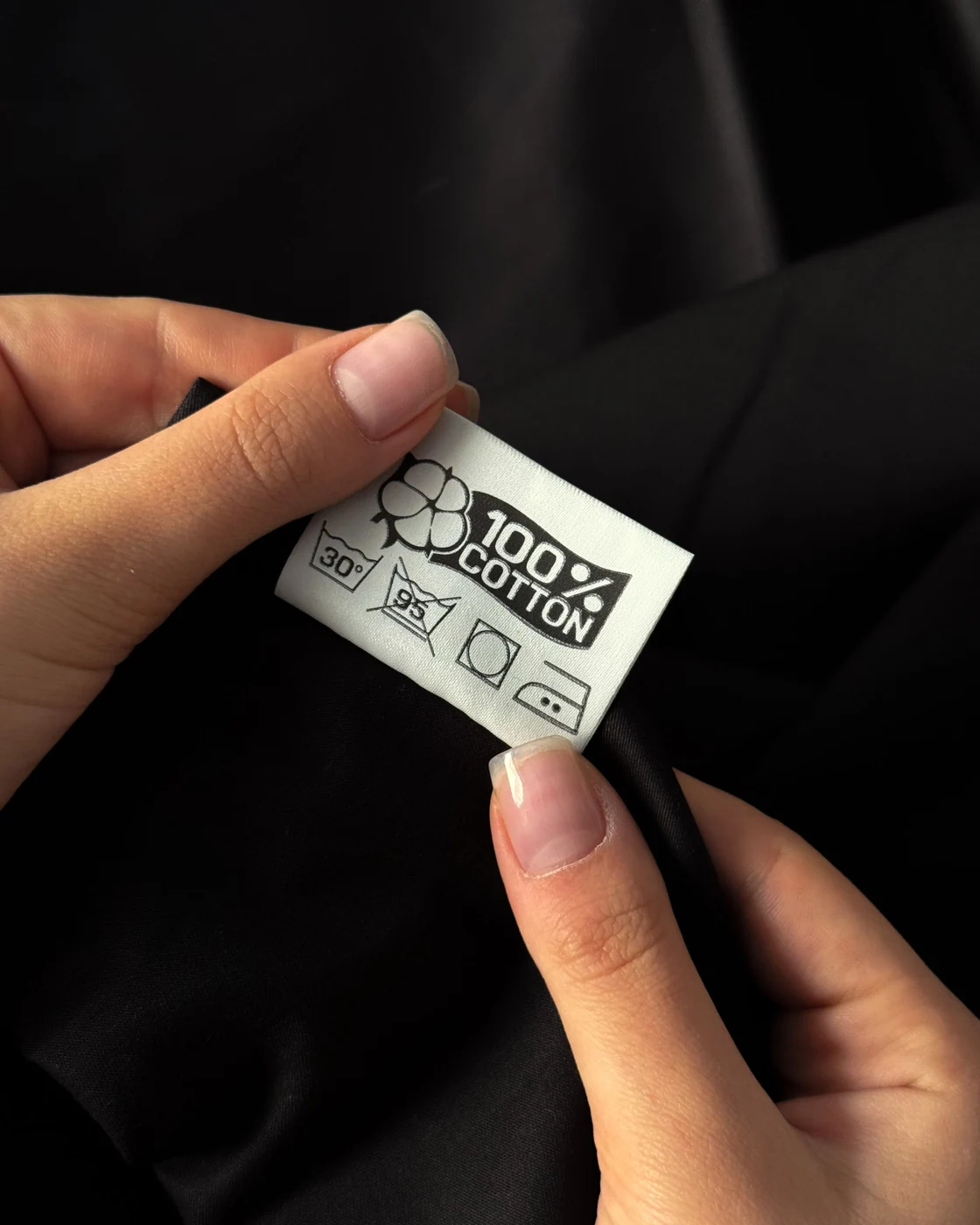
Most markets want four things: fibre content as a percentage, wash and care symbols, country of origin (United Arab Emirates, for us) and size. Some Gulf markets expect Arabic and English together. The rules differ by country, so check yours, or tell us where you sell and we will draft the wording with you.
For ODM or OEM, also send
- Something visual. A photo with notes on what to change, a rough sketch, or a garment posted in. A real garment works best, because fabric weight and fit come across in a way a photo never does.
- A tech pack, if you have one. If you don't, one is written as your style is developed, and you keep it.
- Your target price and quantity, so the supplier can tell you honestly whether it works in the fabric you want.
- Your deadline: the day stock must be on your shelf. If that day falls before Ramadan, work backwards with our Ramadan ordering calendar.
What to do next
Pick a few catalogue styles from the shop and decide which route each one needs. Our private label and custom manufacturing pages carry the full terms. If you are unsure, send a photo and a rough quantity through contact and ask which route fits. A phone snap is enough to start.
Frequently asked questions
Is private label the same as white label?
The words are used loosely. On our private label page, white label means a catalogue design with your label, which other shops can also buy, and private label means a design developed for you alone. Other suppliers use private label for both. Look past the name and ask the real question: can another shop buy this exact abaya?
Do I need a tech pack to order OEM abayas?
Not to start. A photo with notes, a rough sketch or an abaya posted to the supplier is enough to quote and draft a pattern. A posted garment works best, because fabric weight and fit come across. At Dubai Abaya the tech pack is written while your style is developed, and it is yours to keep.
Who owns the pattern when a factory makes my design?
It should be you, and it should be in writing before you pay a deposit. At Dubai Abaya, a design developed with you is kept out of the catalogue and not sold to anyone else, and the pattern is sent to you if you move production. Catalogue styles stay open to every buyer.
Can I start with printed labels and switch to woven later?
Yes, and for most new brands it is the sensible order. Heat seal or printed satin covers a first run without buying hundreds of labels you may never use. Once a style reorders, a woven run of 500 to 1,000 is cheaper per label, and Dubai Abaya stores the balance free and uses it on every order.
How many sample rounds are normal for a custom abaya?
At Dubai Abaya, one round of changes is included for private label and custom work alike, and most styles need exactly one. A second round is priced before it starts. Across general cut-and-sew clothing, one factory guide says most products need two to three rounds, so check what a supplier includes before you compare prices.
Sources
- Mariam's Collection, wholesale enquiries (minimum per style)
- O'Harry Garment, custom abaya product details (minimum per colour per design)
- Arcus, cut and sew manufacturers: costs, MOQs and lead times
- Thygesen Apparel, cut and sew clothing manufacturer guide
- Hicabistan, custom labels
- Quality Woven Labels, FAQ
Our own figures (minimums, prices, deposits, lead times) match our published terms and change everywhere on this site at once. Duty, freight and market figures from third parties are dated and sourced; check them with your broker before you rely on them.